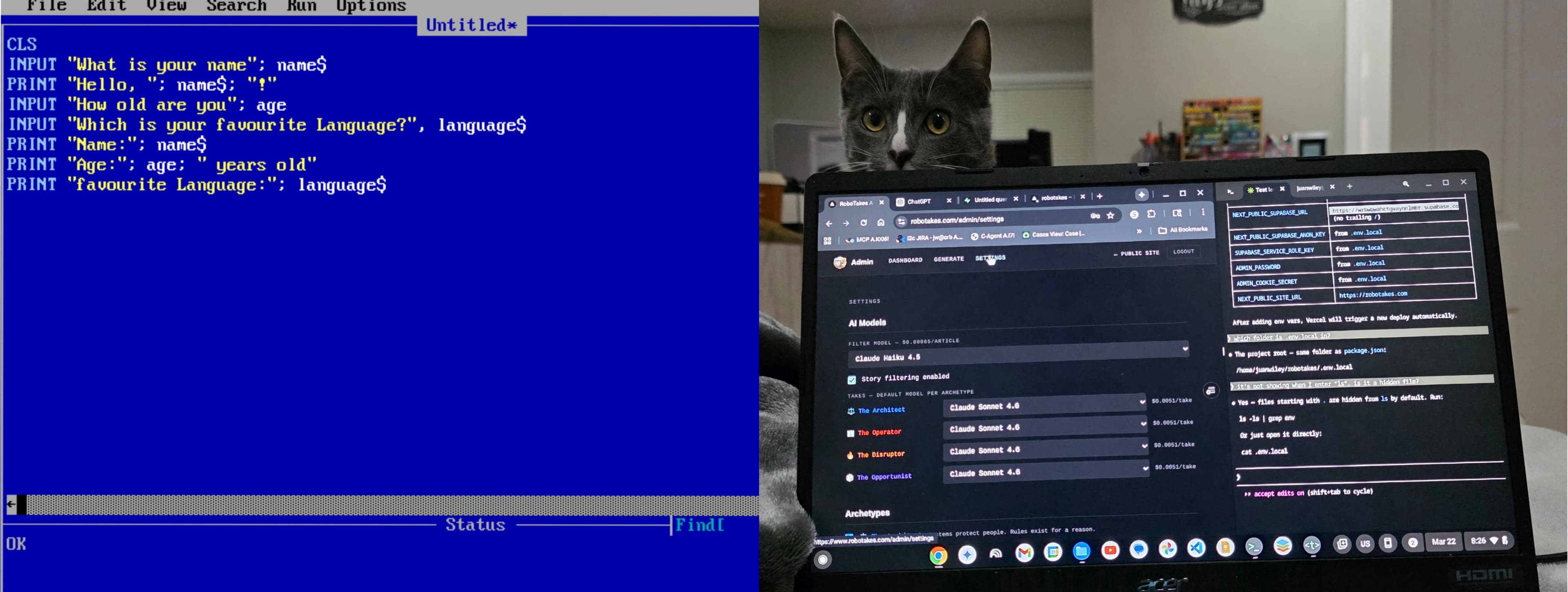
Back to the Terminal
I hadn’t touched a command line in over a decade.
And now I find myself using it again.
My earliest memory of it was that captivating blue glow of QBasic on MS-DOS 5.0. A blinking cursor, a few lines of code, the feeling that if you typed the right thing, something would happen.
I also remember allegedly adding one too many lines to an autoexec.bat file on my uncle’s computer and being blamed when it refused to boot. I still maintain my innocence.
1993 was a long time ago, and I'm almost certain I haven't used CLI this much since those text-based RPG games I coded in 7th grade.
In the many years that passed, work (and play!) moved into interfaces. Buttons, menus, dashboards, structured workflows. In a lot of fields, the real “language” to learn became PowerPoint and Excel, or so did my peers tell me in the 2010s (all came from consulting, mind you). If you could operate inside those, you could get things done without thinking much about what sat underneath.
The command line never went away. It just stopped being part of my world.
Except I’m not using it the way I would have back then. I’m not memorizing commands or navigating directories. I’m describing what I want done, and some thing else is translating that into actions across systems.
The same black (or blue) screen that once felt like a barrier now feels like the most direct path between intent and execution. The kind of interface that used to live in hacker movie scenes has quietly become practical.
What’s changed isn’t just the tool. It’s where the interaction happens.
We’re no longer working through software step by step. We’re stating intent and letting systems carry it out.
And the more seamless that becomes,
the harder it is to tell whether we’re still in the loop, or just briefly part of it.
For a long time, we were the ones translating between systems. We forced them to speak "natural" (to us) language.
Now they’re speaking directly.
And we’re still figuring out where we fit in that conversation.